To: Detroit/Seattle
Workers' Voice mailing list
April 27, 2023
by Pete Brown, Detroit Workers’ Voice
In mid-April, just as another ‘transition’ plan for a democratic civilian government in Sudan was supposed to be taking shape, the leaders of the military junta began squabbling about who would actually be in charge. Squabbling led to gunfights and finally to full-scale civil war as the two main military groups attacked each other’s bases with guns, bombs and fighter aircraft. After a week of fighting, a temporary ceasefire was called for the Islamic festival of Eid al-Fitr and to allow some foreigners and others to evacuate. It was also a time to pick up dead bodies; hundreds have been killed, most of them civilian bystanders. This shows once again the failure of all these ‘transition’ schemes that do not take account of the real interests of the Sudanese masses, those who have suffered through the political oppression and economic rip-offs of previous regimes. Various international agencies – the African Union, the United Nations, the Trilateral Group (Norway, Britain, and the U.S.), and different Mideastern nations – keep concocting various schemes that will give the military rulers of Sudan a civilian face to wear, something that will make their regime look a little bit democratic so that international interests can proceed with looting Sudan’s natural resources. But as long as their schemes refuse to consider the needs and desires of the Sudanese people, they are bound to fail.
The latest comic opera ‘transition’ began last December, when military junta leaders signed a Framework Agreement for transition to civilian rule. From the civilian side, this was signed by the main groups inside the FFC-CC (Forces for Freedom and Change-Central Council). Prior to this, the FFC-CC had held aloof from such an agreement, insisting instead that the coup leaders of October 2021 should step down first. Under pressure from international agencies, FFC-CC agreed to try another ‘transition’ with the same junta leaders who sabotaged the last ‘transition’ when they carried out the coup of Oct. ’21. This is the very definition of insanity – trying the same thing over and over again, hoping for a different outcome.
Just as in 2021, the agreed-upon strategy was to hold talks, and get agreements on, the minor issues first. Anything difficult or contentious was set aside to be decided later, in private consultations. But there was also a time limit imposed on the process. Everything had to be wrapped up by April, to celebrate the fourth anniversary of the overthrow of dictator Omer al-Bashir. Just as in 2021, hands were shaken, poses were struck for the cameras, and the contentious issues – especially security and the armed forces – were put off again and again. Finally, as April approached, and the civilian participants began to insist on something definite, the junta leaders began to chafe under the pressure. According to the Framework Agreement, all armed forces in Sudan were supposed to be consolidated under one command, which would be subject to civilian rule. Presently the official armed forces (the Sudanese Armed Forces, or SAF) are under the command of the junta leader, Abdel Fattah al-Burhan. Al-Burhan’s second in command, Mohamed Hamdan “Hemedti” Dagalo, aside from his official position in the armed forces is also the commander of a semi-official militia called the Rapid Support Force (RSF), which has almost as many men under arms as the SAF (100,000 each). Hemedti was in no hurry to have his private army put under the command of the army leader, especially since FFC-CC leaders were also talking about “accountability” for army officers. Hemedti’s RSF has been responsible for some of the worst massacres imaginable, including torture and rapes, so he balked at such plans. Turning into a slick politician, Hemedti blamed al-Burhan for the delays, accusing al-Burhan of trying to restore the power of al-Bashir’s Islamo-fascists. Mutual accusations led to bullets, as Hemedti’s forces attacked SAF bases and airports. Al-Burhan’s forces replied with fighter jets strafing RSF bases inside cities.
As the fighting spread, civilians were locked in their homes, unable to go out for food or to escape bombardments. It’s estimated that some 400 have been killed. Those injured can hardly get medical treatment, as most hospitals have been closed. It’s unlikely that either side could score a knockout blow on the other, since they are about equal forces, so the outlook for Sudan’s immediate future is grim. With their squabbling, the generals have rendered the Framework Agreement and its ‘transition’ scheme a dead letter. Bourgeois politicians who had spent long hours with UN diplomats figuring out the niceties of the transition are back to square zero. Their plans for stability in Sudan, to ensure steady profits for the exploitation of oil and gold, have gone up in smoke.
Local resistance committees throughout Sudan can justly, but sadly, say “we told
you so.” Since at least the generals’ coup of Oct. 2021, resistance
committees have consistently promoted the “three no’s”: no negotiation,
no partnership, no bargaining with the military junta. They did not
agree with political leaders in the FFC who argued for trying to revive
a ‘transition’ agreement with the generals. They insisted on immediate
transition to a democratic civilian government with control over the
military. Diplomats from the UN and the U.S. held some talks with
resistance committee representatives, but the committees refused to
meet directly with the military, so the imperialist diplomats dropped
the resistance committees from consideration in their ‘transition’
plans. Meanwhile, the resistance committees continued with their
regular weekly demonstrations, called Marches of the Millions,
denouncing the junta leaders and calling on them to step down. Some of
these marches contained hundreds of thousands of people, and they kept
alive the democratic aspirations of the Sudanese masses. The junta
leaders attacked these demonstrations with tear gas, rubber bullets and
occasionally live ammunition. Over 100 protesters have been killed
since Oct. 2021.
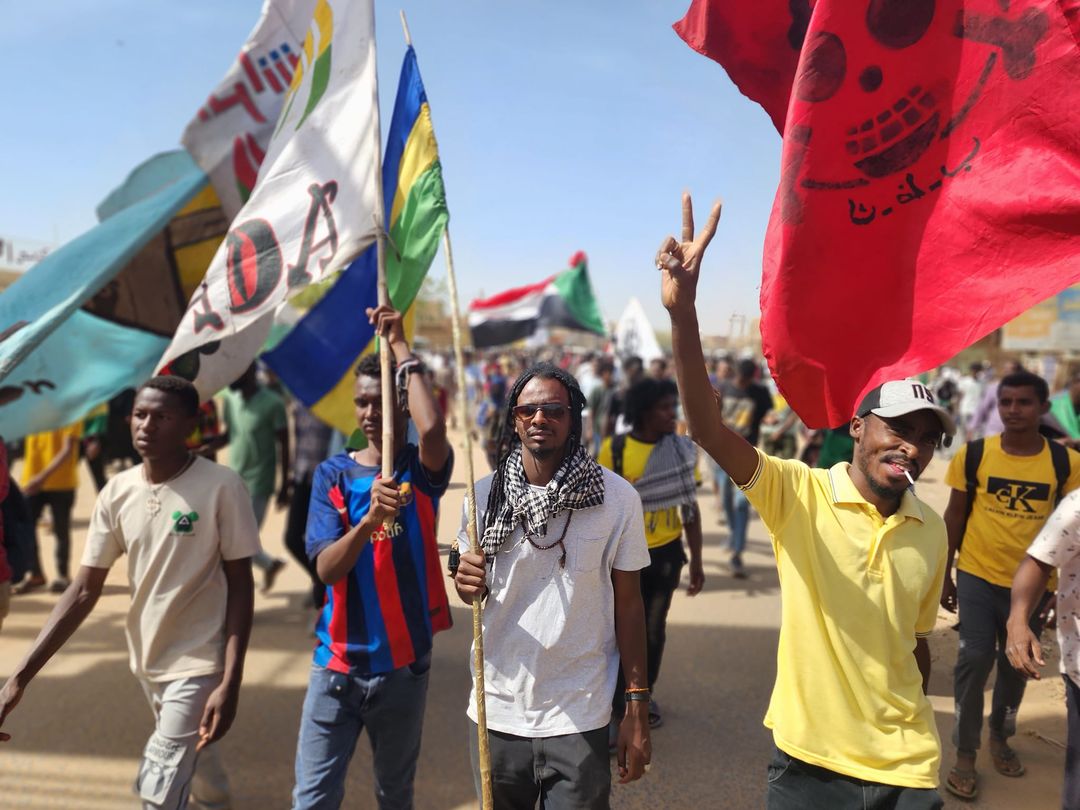
While the demonstrations were large and powerful, some FFC leaders retreated from any attempts at ‘transition’ with the generals. But as the marches slacked off last summer, the idea of accommodation with the generals was revived among the FFC leadership. Some of these leaders had served with Abdallah Hamdok in the previous attempt at ‘transition’ and were eager to try again. But resistance committees continued their stand of the three no’s. When the Framework Agreement was signed last December for a new attempt at ‘transition’, hundreds of resistance committee supporters were outside the meeting hall, loudly chanting their opposition to the Agreement. (1) And as the ‘transition’ wound its way to April, the committees continued their marches in opposition. On March 14, resistance committees held a very large, well-disciplined march in Khartoum. As usual, they insisted on the three no’s. And they rejected Hemedti’s overtures to them as he pretended to be the democratic standard-bearer against Islamo-fascism; they called for Hemedti’s RSF to be disbanded and members of the RSF to face accountability for their crimes. (2) Then, on March 21, there was a large women’s march in Khartoum on the occasion of Sudan’s Mothers’ Day. This was organized by resistance committees and led by Mothers of the Martyrs – mothers of protesters who have been killed by the regime. Junta soldiers held off from physically attacking the women’s march as it proceeded, but afterwards, as it broke up, many women were grabbed and pushed and verbally abused as “prostitutes”. Some were arrested and charged with “abusing the state.” (3)
Thus, there was no reason to expect that junta leaders had turned over a new leaf and were going to peacefully surrender their control of the state. People who expressed demands to that effect were subject to being shot at, tortured, jailed, raped, disappeared and possibly murdered. But as late as April 10, political leaders of the FFC-CC were still optimistic that the ‘transition’ plan would be implemented. (4) This shows how far from reality these bourgeois politicians can become.
As mentioned, the immediate future looks grim. Aside from the political chaos, the economic situation is dire and has been worsening for years. New commercial developments are usually turned over to the military or to close friends of the junta leaders. The junta leaders are able to maintain control by dispensing favors and providing employment. The resistance committees have proven themselves to be strong and consistent advocates for the Sudanese masses. But so far, aside from denouncing the regime, they have not been able to develop an alternative. Resistance committees in Khartoum and Wad Madani have written draft charters for a democratic Sudan but have not yet ironed out differences between the two drafts. (5) They agree on certain basic demands: for a democratic civilian government, rule of law, separation of church and state, consolidation of armed forces and civilian control of the military, accountability for past military leaders’ savagery, etc. All these are important, and the fact that they haven’t been fooled into giving up these demands, even temporarily, shows their consistency in standing up for the Sudanese masses. But while the tactic of organizing mass demonstrations has been helpful in publicizing the aspirations of the masses, so far it has not been effective in winning demands. Oppositional trends are very diverse, from different class backgrounds, and they face the junta’s large, powerful military organizations.
Working class activists in the movement could work to strengthen the movement by raising class-based demands such as trade union rights, economic demands, etc., as well as strengthening the struggle for democratic rights. Pointing out the bourgeois class backgrounds and corruption of FFC leaders could help the masses understand why the FFC leaders repeatedly get manipulated by the junta into phony ‘transition’ schemes.
Mass opposition to the junta has so far come up against murderous suppression by both the SAF and RSF. Even though the imperialist powers – the U.S., UK, etc. – suspend military aid to the junta and even impose sanctions on them, neighboring countries -- Egypt, Saudi Arabia, the UAE, Libya, etc. – are sending arms into Sudan as they choose up sides between the SAF and RSF. Until these forces can be undermined, revolutionaries will face a difficult and dangerous prospect. Agitation among the troops should be a priority, if at all possible. At present, facing off directly with the military would be suicidal, so activists should work to win over sections of the junta’s troops.
The following is a statement issued by resistance committees about the outbreak of violence between the SAF and the RSF, obtained from some activists’ Twitter feeds. They take a pacifist attitude toward armed violence, but that doesn’t mean they are passive or withdrawn from taking political stands. They are very definitely opposed to both junta leaders but are careful not to get drawn into the junta’s cycle of military violence.
Informal translation of statement issued today, 16 April 2023, by the Coordination body of the State of Khartoum Resistance Committees to revolutionaries in the state. (6)
Coordination bodies of the Resistance Committees of Khartoum State
We are not impartial because we have been in a peaceful battle since the era of the ousted al-Bashir until now against the militarization of the country and the control by guns of the streets. We started with nonviolence, and we will continue with it to achieve our goals against all parties to the war now taking place in the streets of the country. Al-Burhan [head of the military] and Hemedti [head of the RSF militia] are enemies of the revolution and the revolutionaries. This is our way; we will win because we are against war and against any outcome that results from it. Both belligerents do not care about the security and safety of our people, so we call on them not to settle their scores among the innocent citizens.
We ask the revolutionaries in the neighborhoods to organize their ranks in the current situation, and to prepare to provide the basic requirements of our people in their areas according to current conditions.
We ask the resistance committees in each neighborhood the below, based on what
they see fitting:
• Monitor the situation on the ground and report what is happening in
and around each neighborhood periodically to prevent rumors, and convey
the facts as they are, in order to be a reliable source for people.
• Form medical rooms to deal with possible injuries and in anticipation of any emergency.
• Monitor the situation of food supplies in the neighborhood,
especially given the possibility of the current war being prolonged,
and look into the conditions of our people in these difficult
circumstances.
• Monitor the security situation in the neighborhood and ensure that
children and the elderly are kept away from the area of clashes.
• Raise the slogan “no to war” and do not respond to any calls for armament because it will lead us to civil war.
• The only one to lose from war are the people, so let us unite to overcome that.
We call on civil society and humanitarian organizations, the Red Crescent and Red Cross organizations, Doctors Without Borders, and the Preliminary Committee of the Sudan Doctors Union to activate their role in aiding the wounded and injured, transferring them to safe places, and providing aid to the Sudanese people until this ordeal is overcome.
Finally, mercy on all the innocent citizens who fell dead; we consider them
martyrs with God Almighty, and we wish a speedy recovery for the injured and the
safe return of the missing.
May God protect our people. The military to the barracks and the Janjaweed dissolved!
Coordination of the Resistance Committees of the State of Khartoum
April 16th, 2023
The undersigned:
• Haj Youssef Neighborhood Committees Group • Khartoum North Committees
• Coordination of East Nile South
• Coordination of the Greater Omdurman Resistance Committees • Coordination of the Resistance Committees of the City of
Khartoum
-----------------------------------------------------------------------------------------------------------------
*the military to the barracks and the janjaweed dissolved
* no negotiation, no partnership, no bargaining
* against the war
* down with the kayzan coup
* every koaz will be stepped on *turning back is impossible
* power is the power of the people
-----------------------------------------------------------------------------------------------------------------
Note: kayzan is the name used in Sudanese Arabic to refer to members of the Islamist-military regime, formerly headed by Omar al-Bashir. The singular is koaz.
The Janjaweed are the ethnic Arab raiders who carried out genocidal attacks on rural settlements in Darfur, killing thousands as they expelled black Africans from their homes. Organized by Hemedti, the Janjaweed became the base of Hemedti’s RSF.
A news item from BBC confirms that the resistance committees are in fact active and helping many people get food, water, medicines and medical assistance. (7)
1. “Sudan’s long-awaited framework agreement signed between military and civilian bodies.” Radio Dabanga, 5 months ago (Dec.
2022).
2. “March of the Millions thwarted by tear gas in Sudan capital”. Radio Dabanga, 1 month ago (March 2023).
3. “March of the Martyrs’ Mothers demands regime change in Sudan”. Radio Dabanga, 1 month ago (March 2023).
4. “Sudan: Yassir Arman expresses optimism about final agreement”. Radio Dabanga, April 10, 2023.
5.The two draft charters were discussed in previous articles on the D/SWV List. See “Sudan: Resistance committees come to the fore of the struggle against the murderous military regime”, February 4, 2022, and “Sudan: resistance committees issue new charter as struggle continues”, March 9, 2022.
6. https://www.facebook.com/photo?fbid=177800888487179&set=a.177800918487176.
7. Mohanad Hashim & Lucy Fleming, “Sudan fighting: The unsung heroes keeping Khartoum residents alive”. BBC News, A[ro; 22. 2-23.
Picture: A demonstration in March by the resistance committees.
Back to main
page,
how to order CV,
write us!