To: Detroit/Seattle
Workers' Voice mailing list
January 27, 2022
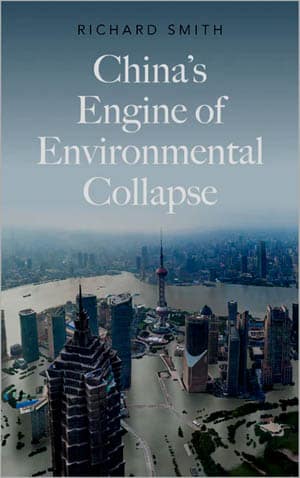
(An expanded version of notes on the April 8, 2021 discussion held by a study group reading Smith’s book.)
by Joseph Green, Detroit Workers’ Voice
While Chapter 5 contained more information about the ongoing environmental tragedy in China, it focused on the question of why the Chinese system does this. Some leftists believe that the Chinese economy is directed smoothly from a center, and this is reflected in Smith’s view of the economy as “bureaucratic collectivism”. This would lead to the view that the national government was free from economic compulsion and could make policy choices as it chose, and that wrong choices were most of the problem. But Smith’s descriptions of what goes on in China depict competition between ministries, between the center and the localities, and between state-owned entities, and not simply between the privately-owned firms. This is a form of the anarchy of production, which is a major feature of Marx’s description of capitalism, and it is not something the Chinese government chose or wanted, but exists in defiance of its will. And this anarchy is typical of state-capitalist systems; it is something that they share in common with the US and other Western capitalist economies. It is one of the chief causes of the environmental devastation common to China and the Western capitalist economies.
The chapter begins by citing Xi Jinping’s elevation of the State Environmental Protection Agency (SEPA) to ministerial rank as the Ministry of Environmental Protection (MEP), his declarations in favor of the environment, and various practical steps he has taken to improve the environment. These steps include shutting down “tens of thousands of smaller private polluters”, but, Smith points out, “the same heavy hand” was not applied to “state-owned companies, the biggest polluters”. Chapter 5 is devoted to showing some of the systematic reasons why, despite these actions by Xi, the situation keeps getting worse; “one need not doubt Xi’s sincerity”, Smith writes, but the basic nature of the present Chinese system is resulting in “China’s ‘blind investment,’ ‘blind growth,’ ‘blind production,’ out-of-control resource consumption, and wanton pollution—what Xi himself describes as ‘meaningless development at the cost of the environment.’”
The speed of China’s economic growth is astonishing — for example, in 2016 alone China built the equivalent of 363 Golden Gate bridges. Many great construction projects have been built, although they were built whether they were needed or not. In the course of this massive growth, millions of peasants have been pushed off the land, thus losing their position in life. Railroads, roads, and bridges are being built to allow the creation of three giant megalopolises. One of them will consist of Beijing, Tianjin, and Hebei essentially merging into one huge urban region of 130 million people, as much as the total population of Japan, in an area of 82,000 square miles.
Smith's explanation of the drive to expand centers on conscious policy decisions such as the drive to keep up with and exceed the West. He underplays the internal nature of the system that operates, even in the state sector, in defiance of official decisions, and this leads him to regard the Chinese economy as not capitalist, although bureaucratic. He writes that: “Capitalist economies are driven by a single maximand: Profit. China’s statist-bureaucratic mode of production is driven by a different maximand: Maintaining the security, power, and wealth of the Party bureaucracy. …. In China’s state-owned economy, growth is driven by the conscious decisions of Party authorities.” (p. 91)
So Smith calls the system “bureaucratic-collectivist” to distinguish it from profit-driven capitalism, and he claims the Chinese economy is largely exempt from the laws of a capitalist economy. For him, the Chinese system sort of is and isn’t capitalism. He says that Chinese market reforms didn’t solve the problems of inefficiency, resource waste, energy waste, lack of specialization, etc. which market-crusading economists had promised they would, because to do so it would have been necessary to go to a fully capitalist economy; he wrote that, as he 'argued in my 1989 doctoral thesis...the only way to make the state economy work like a capitalist economy would have been to actually make it a capitalist economy.' (p. 99) Mind you, he doesn’t think capitalism will solve the environmental crisis, but nevertheless he holds that capitalist market discipline creates a certain efficiency, etc. And he doesn’t see the state sector as really capitalist.
So Smith view divorces the hyper-growth and hyper-pollution of the Chinese economy from ordinary capitalism. But is that so? One comrade said that the results of Chinese hyper-growth reminded him of Detroit and Buffalo. They were once busy capitalist cities, but presently large parts are in ruin. Why? The auto companies and their plants over-expanded, then collapsed, leaving ruins. Another comrade pointed out that, while Smith says that China is largely exempt from capitalist economic tendencies, he describes the economic pressures in China, which, in fact, are reminiscent of capitalism elsewhere, and these pressures lie behind the environmental disaster. His descriptions of Chinese reality, which are quite valuable, often go against his theorizing.
The comrade went on to say that Smith apparently picks up his theory of “bureaucratic collectivism” from the views of Max Schachtman and James Burnham. Trotskyism sees the state ownership as going beyond capitalism, so most Trotskyists deny that the Stalinist economies are state-capitalist. They regard the state sector in itself as socialistic, or at least collectivist, because it can supposedly do what it wants independent of market pressure.
But in practice the Stalinist economies can’t actually do that, and different Trotskyist trends have different ways of dealing with this. In his book The Revolution Betrayed, Trotsky says that the USSR under Stalin was economically socialist but had bad leadership; he thus advocated that there had to be a political revolution but not a social one. So one simply had to change the leaders, not the economic system. Schactman’s views were somewhat different. He held that the Stalinist regime was not socialist—degenerated, deformed or otherwise--but “bureaucratic collectivist”. The greater role of the state in the Stalinist economy meant, for him, that it couldn’t be capitalist, but must be some form of “collectivism”, albeit a bad, bureaucratic form.
Neither Trotsky nor Schachtman really understood the extent of how capitalism evolves, and that state-capitalism is simply a variant of it. Major changes in capitalism had taken place before, and then in the 20th century, state-capitalism became one of its prominent forms. Thus, in the early 19th century there were largely individual or private owners running their enterprises. By the end of the 19th century, there was the development of joint-stock companies, or corporations, in which there is the separation of management and ownership, and a tremendous growth of large-scale production. This was a major change, and it looked quite different from the old capitalism to the people who saw it develop in front of them, but it was still capitalism. Marx too thought it was a very significant change, and he wrote dramatically in Capital that the rise of the joint-stock company was “the abolition of capital as private property within the framework of capitalist production itself”, and it was even “the abolition of the capitalist mode of production within the capitalist mode of production itself”. (Capital, vol. III, Ch. XXVII “The role of Credit in Capitalist Production”, pp. 437-8. The meaning of this view of Marx is discussed at greater length at www.communistvoice.org/12cSovAnarchy.html.) Since then, there have been other major changes in Western capitalism, such as the spectacular increases in the role and power of finance and fictitious capital, of the state role even in market capitalism, and of globalization. Meanwhile after the revolutions died away in Russia and China, the Stalinist and Chinese economic systems were themselves further variants of capitalism; these systems were still capitalism, albeit state-capitalism.
Smith tends to separate how things are done under China’s “bureaucratic collectivism” from how they are done here in the US and in Western capitalism in general, but when one sees Smith's description of Chinese cadre stripping firms of assets, it is reminiscent of how vulture capitalists in the West strip firms. He also describes how the Chinese system changes every ten to twenty years -- first Maoism, then various market forms, then the later growth of these forms. He goes especially into the growth of corruption; as time goes on, this corruption is spectacular compared to what it was originally. In the West we also see changes, such as the growing domination of huge masses of paper values and fictitious capital. Smith points out in a later chapter, chapter 6, although he doesn't give as much significance to it as he might have, that the Chinese officials and princelings (children of China's top leaders), when they attended Western universities, learned from Western financiers a lot about how to strip assets from enterprises and grow rich on parasitism. (pp. 142-44)
One comrade said that Smith gives as evidence of how things are different from capitalism that none of the princelings own property in their own name; they have all this wealth in other forms, such as wealth owned by the state. And Chinese state ventures don't have to make a profit; they survive despite losses. Smith thinks this proves that China isn’t subject to the laws of capitalist competition, but then he describes the violence of this competition.
Another comrade gave the example of the privatization of the land. The Chinese government privatized the countryside, and threw hundreds of millions of peasants off the land, in part with the intention of vastly increasing urbanization. From Smith's point of view, this was possible because of the state ownership of the land, but nevertheless, it was privatization dispossessing the farmers. Meanwhile in the West, you may own a house, but if the capitalists really want to build something, they can throw you off the land; we discussed several examples of that.
Smith's view was that when the ministries direct resources, this is not capitalism, but collectivism. But in the US, various major projects -- from the transcontinental railroad system to travel to Mars -- were done because the government threw in the money for them, not because of the market.
Some of the things that Smith emphasizes about China were emphasized in the description of the Stalinist economy in Russia by my 1997 article "The anarchy of production under the veneer of Soviet revisionist planning". One of the subheads is "The ministry rules", as the ministries can direct large amounts of resources where they wish. The next subhead reads "The ministry doesn't rule", and it introduces a discussion of the fierce anarchy in the Stalinist economy which severely limited what the ministries could do and turned planning figures and government directives into fantasies. This is similar to some of the things described by Smith, but the article drew a different conclusion from this than Smith does. He says this is characteristic of bureaucratic collectivism, not state-capitalism. But the facts being described are similar: the economic competition between plants, between ministries, and between ministries and plants.
One comrade raised some questions about the box on pages 109-10 where Smith gives his views about what the Chinese leadership learned from the collapse of the Soviet Union and how it was able to avoid the destruction of the dictatorship of the ruling party. The Chinese leadership wanted privatization, but without removing the “Communist” Party in power or providing the working masses any democratic rights. How far was this different from Russia, given that some of the people in power today are those who formerly held important positions in the Soviet ruling party? Now, the collapse of the Soviet Union had led to a period of economic collapse, but the privatization in China didn’t, although hundreds of millions of peasants were forced off the land. It seemed that Smith was saying that the way things happened was just the result of policies. But weren’t the changes, at least in the case of the USSR, forced by the developing situation, and the mass uprising that was going on there? Was there any alternative that the leadership could have followed?
Another point is that Smith says that "in the bizarre accounting practices of China's state-owned economy, even if a product has no use value, even if it fails to sell or rent out, it's still counted toward the GDP." (p. 98) He holds that in the US, if a product doesn't count for the bottom-line, it won't count for the GDP. But is that so? If something is produced, whether or not it later sells on the market, it goes in the GDP. There are lots of empty or useless assets that are maintained on the corporate books. Western capitalism is a master of fictitious capital.
Finally, we noted that the March 2021 issue of Monthly Review had an issue on China with an Editors Note that denounced Smith's book. But a website associated with MR, namely “Climate and Capitalism”, reprinted from the Australian journal the Green Left a review by Chris Slee of Smith’s book that said "the book is well worth reading. It is very informative, and Smith is right to point to the need for system change, both in China and in countries such as the US." <>
Back to main
page,
how to order CV,
write us!